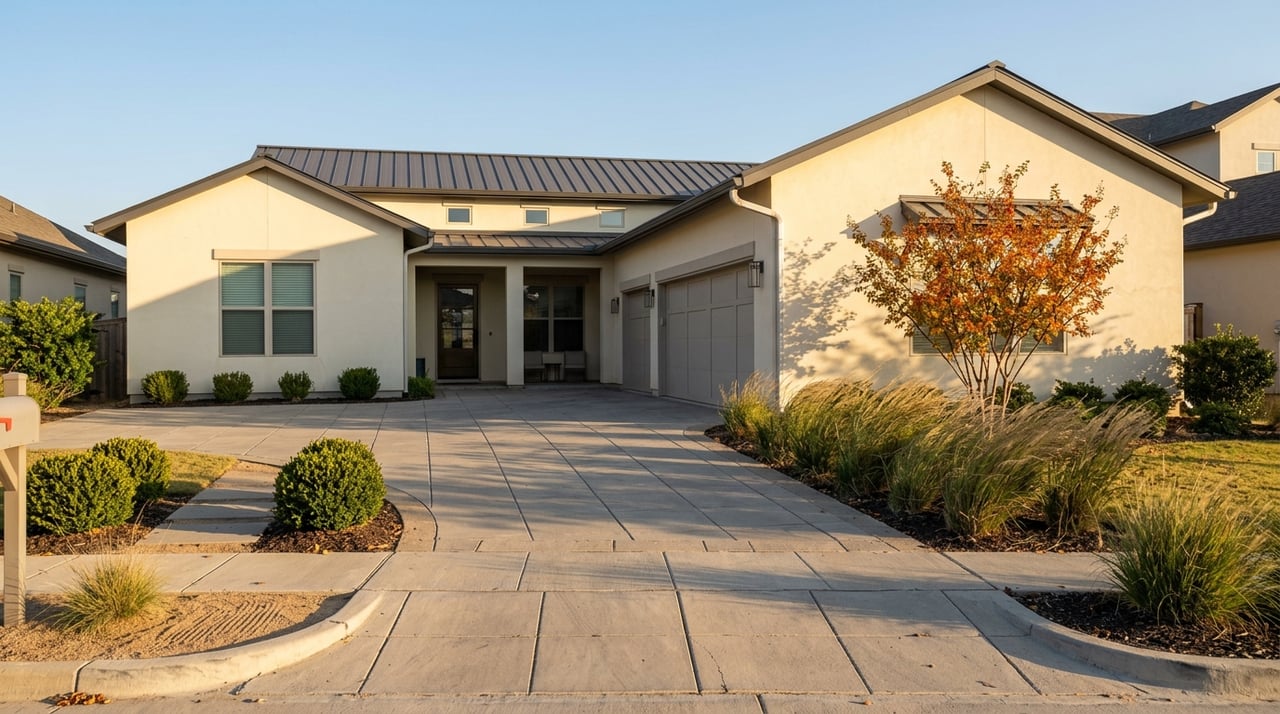
A buyer falls for a home in Sterling Ranch. The listing sheet shows a tax figure lifted straight from the county's public record, a number that looks almost suburban-normal next to the home's price. Then the first real bill arrives, calculated on the home as built and assessed rather than the dirt lot it replaced, and the number is meaningfully higher. Nobody lied. The county simply hadn't caught up yet, and the mill levy doing the heavy lifting wasn't fixed to begin with.
That gap is not a Sterling Ranch quirk so much as a metro district feature, but Sterling Ranch is where the mechanism is easiest to see, because the community's own marketing has been repeating one number for years while at least one of its seven districts has already moved well past it.
Where the 88.444 Number Comes From
Ask around Sterling Ranch about property taxes and you will eventually land on the same figure: an 88.444 mill levy, described as the community's stand-in for an HOA fee. It is a genuinely useful way to think about the structure. Sterling Ranch does not charge HOA dues in the traditional sense. Instead, the Metro District's mill levy covers what an HOA normally would, snow removal, recreation center access, and landscaping of common grounds, plus one amenity that is unusual for the category: an annual pass to Colorado's state parks bundled into the levy.
That figure comes from the community's own explanation of how the math works, and it is not wrong. It is dated. It reflects one district at one point in its life cycle, and Sterling Ranch is not one district. It is seven, plus a handful of subdistricts layered inside some of them, each with its own board and its own certified rate.
What One District Is Actually Certifying Now
A more recent look at Douglas County's special district filings found that Sterling Ranch Colorado Metropolitan District No. 3 alone certified 33.284 mills for general operations and 62.238 mills for debt service in its most recent budget cycle, a combined 95.5 mills before any other taxing authority touches the bill. That's not a typo of the marketing figure. It's a different, higher number, and it belongs to a different district than the one most often quoted.
The same reporting placed Sterling Ranch's levies among the highest in Douglas County for active new construction, and used a neighboring Castle Rock development called Dawson Trails as a comparison point. Dawson Trails, a roughly 2,000-acre project anchored by an incoming Costco and a new Crystal Valley Parkway interchange on I-25, levies 74.044 mills across its seven districts. That rate, the reporting noted, runs about seven times what residents in Highlands Ranch pay. Sterling Ranch's own District No. 3 sits above even that.
The point isn't that Sterling Ranch is uniquely expensive. It's that "the mill levy" is not a single fact you can look up once and carry into every offer. It is a moving number tied to a moving number of homes.
What the Combined Bill Actually Looks Like
Property taxes on any Sterling Ranch home stack several taxing authorities on top of each other. The community's own accounting lists twelve separate entities assessing mills against Sterling Ranch properties, with three doing most of the work.
| Taxing entity | Mills | Share of total |
|---|---|---|
| Sterling Ranch Colorado Metro District | 88.444 | Largest single line |
| Douglas County Re-1 School District | 30.942 | Second largest |
| Douglas County government | 19.774 | Third largest |
| Nine remaining entities, combined | roughly 25 | Balance |
Add those up and you get the total mill rate applied to a home's assessed value, roughly 165.5 mills using the community's own worked example. On a $500,000 home assessed at Colorado's 7.20 percent residential rate, that produces an assessed value of $36,000, and a combined annual tax bill in the neighborhood of $5,959 by that same calculation.
Two things are worth sitting with here. First, the assessment rate itself isn't fixed either. Colorado's legislature resets it every odd-numbered year, and it was 7.96 percent not long before it became 7.20 percent, which means the same home's tax bill can shift even if every mill levy stays flat. Second, that $5,959 example assumes the Metro District line stays at 88.444 mills. If your specific lot falls inside District No. 3, or another district that has since certified a higher debt-service rate, the real number climbs from there.
Why the Number Moves
The Metro District's own 2026 budget language explains the mechanism plainly. Property taxes collected through the debt service mill levy, along with specific ownership taxes, get transferred to Sterling Ranch's Community Authority Board to pay principal and interest on bonds the CAB issued in 2024. That's the debt-service half of a district's mill levy in a sentence: it exists to service bonds, and it is sized to whatever those bonds currently require.
The operating half of the levy, the part that funds day-to-day maintenance and amenities, is a separate number that can also move year to year based on the district's budget. When a district like No. 3 reports 33.284 operating mills plus 62.238 debt service mills, those are two different decisions stacked into one certified rate, and either half can shift independently in a future budget cycle.
There's a second layer worth knowing about if you're comparing lots across different sections of the community. The water and sewer infrastructure behind Sterling Ranch runs through a separate entity, Dominion Water and Sanitation District, funded primarily through one-time tap fees paid when new homes connect rather than through an ongoing mill levy. Dominion's own 2025 numbers came in well under budget, roughly $8.3 million in water tap fees against a $13.6 million projection, a shortfall tied to slower-than-planned new construction. That gap doesn't show up on your tax bill directly, but it says something about the pace of building in different sections of Sterling Ranch, which in turn affects how quickly a given district's debt gets spread across enough rooftops to bring its per-home mill rate down over time.
The Deduction Most Buyers Get Backwards
Here's the detail that actually favors Sterling Ranch buyers once they understand the structure. A traditional HOA fee is not tax deductible under standard homeownership deductions. A mill levy, because it's collected as part of your property tax bill, generally is. If you're comparing a Sterling Ranch home against a similarly priced house in a neighborhood with a conventional $150 or $200 monthly HOA fee, the sticker shock of a higher mill levy needs to be weighed against the fact that one of those costs may reduce your taxable income and the other never will. That's not tax advice, it's a structural difference worth raising with whoever prepares your return, but it's the kind of nuance that gets lost when people only compare the top-line dollar figures.
What Colorado Law Actually Requires Sellers to Hand You
None of this is information buyers have to dig for on their own. Colorado law has caught up to metro district transparency in a meaningful way over the past few years. For any sale closing on or after January 1, 2024, an owner of residential property inside a metropolitan district organized on or after January 1, 2000 is required to give the buyer the district's official website. Districts that have existed since August 7, 2013 are separately required to have recorded a public disclosure document with the county clerk and recorder, naming the district and describing what its service plan authorizes it to do.
Douglas County's public notice archive shows exactly this kind of paper trail for Sterling Ranch, with disclosure notices recorded for Districts 1 through 7 and multiple subdistricts. That means the specific mill rate, debt authorization, and board meeting schedule for the exact district your lot sits in is a matter of public record, not something you have to take on faith from a sales office.
Questions Worth Asking Before You Write an Offer
- Which Sterling Ranch Metro District number, and which subdistrict if applicable, does this specific lot fall inside
- What is that district's current certified mill rate, split between operating and debt service
- Does the tax figure on the listing reflect the land's prior assessed value or the home as it will be assessed once built and occupied
- Has the district recorded its required disclosure document with Douglas County, and can you get a copy before closing
- Is the district's bonded debt still in its early repayment years, when debt-service mills tend to run highest, or further along
A Few Questions Worth Settling Early
Does every home in Sterling Ranch pay the same mill levy? No. The rate is set district by district, and Sterling Ranch is organized as seven metro districts with several subdistricts layered inside some of them. A home in one district can carry a meaningfully different combined rate than a home a few streets over in another.
Will the mill levy go down once the bonds are paid off? The debt-service portion is specifically tied to repaying bonds, so in structure it should decline as that debt is retired. The operating portion is a separate, ongoing budget decision and isn't tied to a payoff date.
Is the mill levy really equivalent to an HOA fee? Functionally, yes, in that it funds the shared amenities and maintenance an HOA normally would. Financially, the comparison isn't one to one, since the mill levy is generally deductible as part of your property tax and a traditional HOA fee is not.
Sterling Ranch is still a genuinely well-regarded, fast-selling master-planned community, and none of this changes that. It does mean the tax line on a listing sheet deserves the same scrutiny as the price itself. If you're weighing a specific Sterling Ranch address against homes in Highlands Ranch, Castle Rock, or elsewhere in the south metro, the mill levy attached to that exact lot is knowable before you ever write an offer, and it's worth knowing.
If you'd like help pulling the district-specific numbers for a home you're considering, or comparing what a Sterling Ranch mill levy actually costs against a traditional HOA fee elsewhere in the Denver metro, Lisa Wynne can walk through the math with you. Let's Connect.